
Subtotal $0.00
 Make Appointment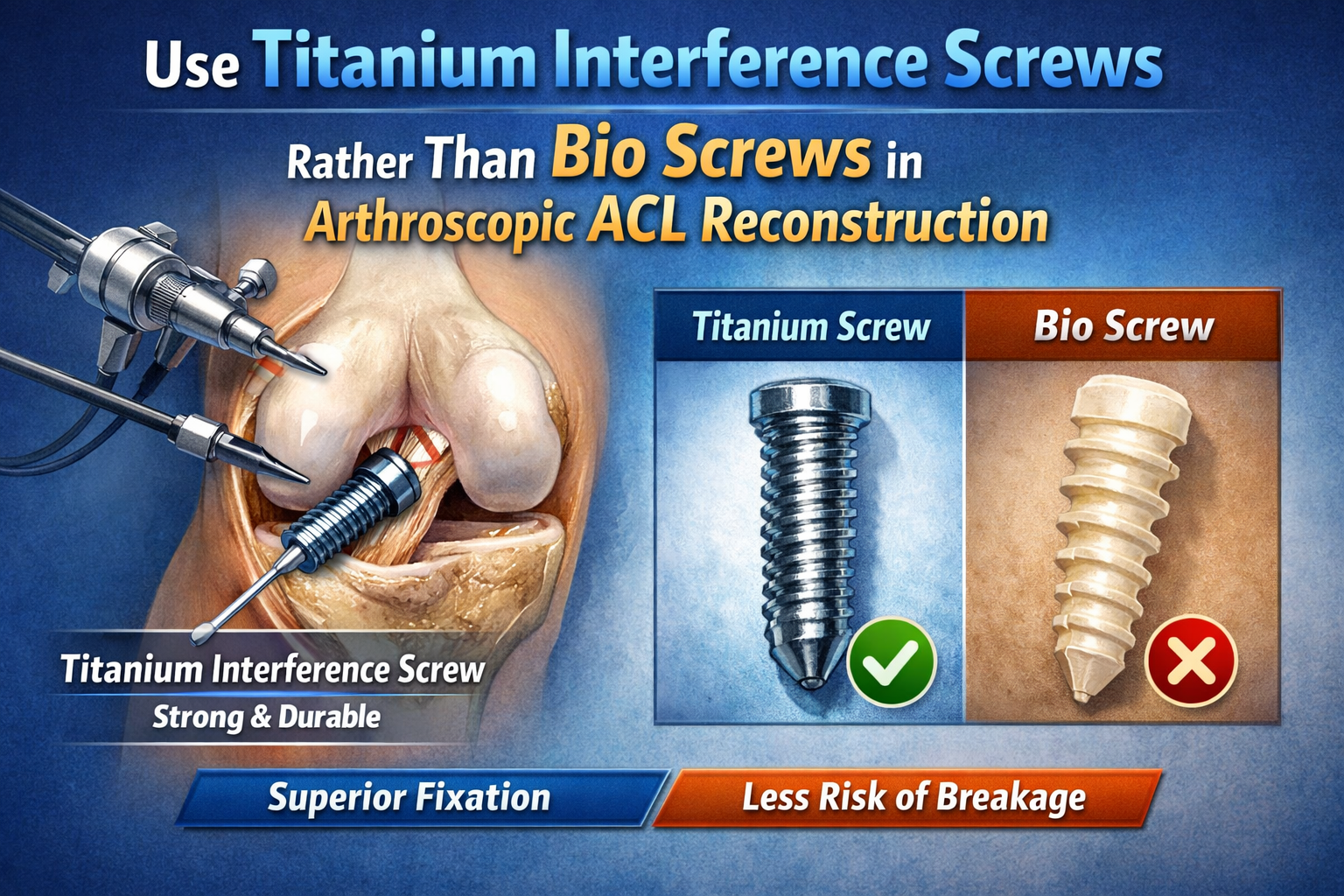
To Reduce the Chances of Post-Operative Infection
Arthroscopic ACL reconstruction is one of the most commonly performed procedures in orthopaedic sports medicine. While the surgery is generally successful, post-operative infection remains one of its most serious complications. When infection develops after ACL reconstruction, it can threaten graft survival, damage the joint cartilage, delay rehabilitation, and sometimes lead to permanent functional loss.
One important but often under-discussed factor in infection prevention is the choice of interference screw used for graft fixation. Although both titanium and bioabsorbable screws are used in ACL reconstruction, growing clinical and biological evidence suggests that titanium interference screws may offer a safer profile when it comes to post-operative infection risk.
Why the Choice of Interference Screw Matters
In ACL reconstruction, the interference screw secures the graft inside the bone tunnel during the early healing period. This is a critical time, because the graft is still integrating with bone and remains vulnerable.
If infection develops during this phase, the results can be devastating. Patients may require:
Arthroscopic washout
Prolonged antibiotic treatment
Graft removal in severe cases
Revision surgery later
Because of this, implant choice should not be seen only as a matter of fixation preference. It is also a matter of patient safety and infection prevention.
Titanium vs Bio Screws: What Is the Difference?
Titanium Interference Screws
Titanium screws are made from medical-grade titanium alloy. They are strong, stable, radio-opaque, and biologically inert once integrated into bone. They do not degrade over time and do not release by-products into the surrounding tissues.
Bioabsorbable Interference Screws
Bio screws are made from absorbable polymers such as PLLA or PGLA. These materials gradually break down inside the body over months or years. While they were introduced with theoretical advantages such as reduced MRI artefact and no permanent metal implant, their biological behaviour has raised important concerns.
Why Bio Screws May Increase Infection Risk
1. Acidic Environment During Degradation
As bioabsorbable screws degrade, they release lactic acid and glycolic acid. In the confined environment of the bone tunnel, this can create a local acidic micro-environment.
This matters because acidic conditions may:
Reduce neutrophil and macrophage function
Lower the effectiveness of antibiotics
Support bacterial survival in the tunnel
In simple words, the local environment becomes less favourable for the body’s immune defence and more favourable for infection.
2. Higher Potential for Bacterial Adhesion and Biofilm Formation
As bio screws degrade, their surface may become more porous and irregular. These microscopic changes can create ideal conditions for bacterial attachment and biofilm formation.
Biofilm is especially dangerous because once bacteria form a biofilm on an implant, they become much harder to eliminate with antibiotics or immune response.
Titanium, in comparison, has a smoother and more inert surface with lower bacterial adhesion potential.
3. Foreign Body Reaction Can Mimic or Support Infection
Bioabsorbable screws are known to cause sterile inflammatory reactions in some patients. These reactions may produce swelling, pain, raised inflammatory markers, and even cyst formation.
This creates two problems:
It may mimic infection and lead to confusion in diagnosis
It may maintain a chronic inflammatory environment that is not ideal for healing
Titanium screws do not undergo degradation and therefore do not trigger this prolonged foreign body response.
4. Delayed or Compromised Graft-Tunnel Healing
The degradation-related inflammatory response around bio screws may also interfere with normal graft incorporation inside the tunnel. A prolonged inflammatory environment can weaken healing and leave the graft biologically vulnerable for longer.
What Clinical Experience Suggests
Clinical studies and registry observations have shown a consistent pattern: bioabsorbable interference screws are associated with higher rates of post-operative infection, inflammatory tunnel reactions, sterile effusions, and tunnel cyst formation compared with titanium screws.
While direct high-level head-to-head trials remain limited, the overall signal from published evidence supports the view that titanium screws offer a more predictable and safer post-operative course.
In practical terms, titanium screws are associated with:
Lower infection risk
Less tunnel osteolysis
Fewer inflammatory complications
Easier post-operative interpretation
Better management options if infection does occur
Why Titanium Is Often the Better Choice
Titanium interference screws offer several practical advantages:
Strong and reliable fixation
No acidic degradation products
Lower biofilm tendency
No chronic polymer-related inflammatory reaction
Better visibility on X-ray and CT
Lower cost in many settings
Easier planning in revision cases
Even the traditional concern about MRI artefact with titanium is now much less important because modern MRI protocols can significantly reduce metal artefact.
What Happens If Infection Occurs?
When infection develops after ACL reconstruction, management becomes far more difficult if a bio screw is involved.
With Titanium Screws
The infection can often be treated with washout, antibiotics, and graft retention if diagnosed early. Titanium itself is less likely to serve as a persistent nidus for infection.
With Bio Screws
The situation is more complex. A degrading bio screw may harbour bacteria within its porous structure, and removal can be technically difficult or incomplete. This may reduce the chance of graft salvage and increase the likelihood of staged revision surgery later.
Additional Concerns With Bio Screws
Apart from infection, bioabsorbable screws have also been linked with:
Tunnel widening
Osteolysis
Cyst formation
Screw breakage during insertion
Difficult revision surgery due to degraded tunnel quality
These issues further weaken the case for routine use of bio screws when a safer alternative is available.
The Practical Takeaway
For surgeons performing ACL reconstruction, the choice of interference screw should be made with long-term safety in mind. Mechanical fixation is important, but so is the biological environment created around the healing graft.
Titanium interference screws provide:
Stable fixation
Better biological compatibility
Lower infection risk
Fewer inflammatory complications
More predictable recovery
This makes titanium the more dependable option for most ACL reconstructions.
Conclusion
In arthroscopic ACL reconstruction, the interference screw is more than a fixation device. It remains in close contact with the healing graft during the most critical months of recovery. That makes implant material highly relevant.
Bioabsorbable screws may appear attractive because they avoid permanent metal, but their degradation can create an acidic, inflammatory, and infection-prone environment inside the tunnel. Titanium screws avoid these issues and offer a safer and more predictable post-operative course.
For reducing the chances of post-operative infection and protecting graft healing, titanium interference screws should be strongly preferred over bio screws in arthroscopic ACL reconstruction.