Understanding MCL Injury

  • Home
  • Understanding MCL Injury

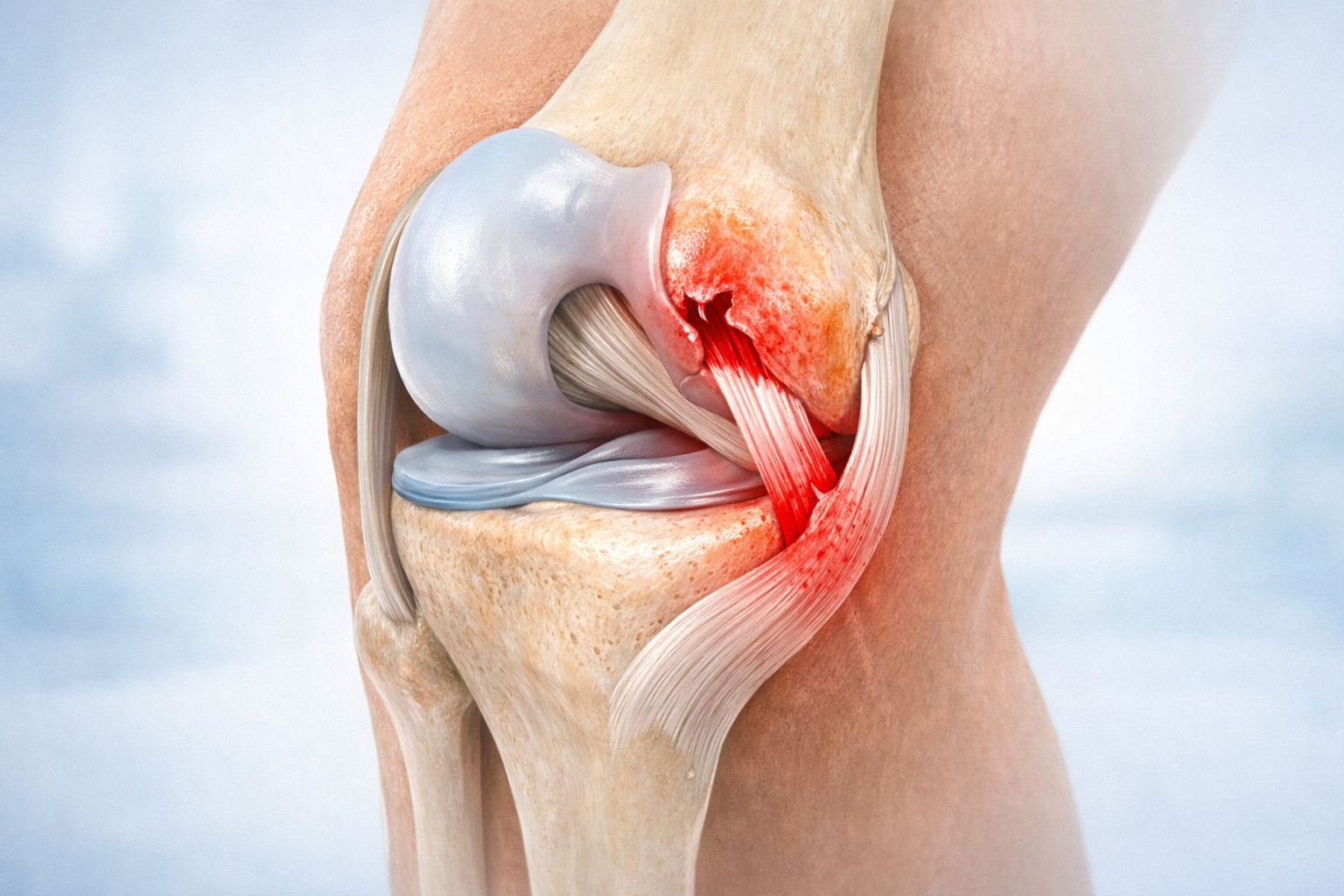
Medial Collateral Ligament(MCL)  is one of the most collateral ligament of the knee joint, is a long rather narrow, well-delineated structure lying superficial to the medial capsule and capsular ligament , originating from the medial femur epicondyle and inserting 7 to 10 cm below the joint line on the posterior half of the medial surface of the tibial metaphysis deep to the pes anserinus tendons.

Biomechanically  it’s the primary restraint and provides the principal knee stability to the Valgus stress. Its one of the  most important and pivotal ligament of the Knee joint.

Causes of MCL Tear
Complications of Untreated MCL Tear

Treatment of MCL Tear

Over the recent years, lot many advances are made in the treatment of MCL Tear . The type of treatment offered depends on many factors and no single method is the best! Your Joint specialist who is trained in all modalities can guide you to choose the best possible treatment or you !

1. Medicines and Knee physiotherapy

Partial and stable tears , MCL swelling and no other co- ligament injuries can be treated conservatively with nsaids and Knee physiotherapy.

2. Open MCL Repair

Acute MCL injuries, Grade 3 complete MCL tears and concomitant injuries like ACL or meniscal injury requires surgical repair whereby the torn ends are sutured using Fiberwire and the injuries adjacent either to distal femur or proximal tibia are fixed using Suture pull out techniques which are gold standard techniques for the treatment of Acute MCL tears

3. Open MCL Reconstruction

In Chronic MCL tears , the ends of MCL are retracted and hence cannot be repaired , in such cases MCL Reconstruction is done in which semitendinosus and gracilis are harvested using open stripper , converted to thick ligament and reconstructed in the place of native MCL – its gold standard in the treatment of Chronic MCL Injuries.

Do you have questions? Contact Us

    Joint Replacement
    Joint Arthroscopy
    Joint Preservation Surgery
    Sports Injuries
    Orthopedics Trauma
    Illizarov and Limb Reconstruction
    Bone nonunion
    Bone and Joint Infections
    Paediatric Trauma and pediatric deformity correction surgeries
    quote

    The professionalism and efficiency of the clinic made my visit smooth and stress-free. I highly recommend Dr. Jakob Smith and Medova to anyone in need of top-quality medical care.

    testi_1_1

    Monika Zuli

    Heart Patient

    quote

    The level of care and personalized treatment I received exceeded my expectations. Dr. Smith's dedication and the friendly atmosphere made the difference. Dr. Smith's expertise

    testi_1_2

    Lucas Fletcher

    Diet Patient

    FACTS & NUMBERS

    95%

    Of Patients Recommeded Dr. Hiren Patel

    Opening Hours

    Most medical centers offer charity programs, counseling, and financial assistance for those in need.

    Moday 8:00AM - 5:30PMTuesday 8:00AM - 5:30PMWednesday 8:00AM - 5:30PMThursday 8:00AM - 5:30PMFriday 8:00AM - 5:30PMSaturday 8:00AM - 5:30PM
    FAQ’S

    Frequently Ask Questions

    Knee ligament injuries like ACL, PCL, MCL, and meniscus tears are commonly caused by sports injuries, road traffic accidents, falls from height, degenerative changes, or inflammatory conditions.

    Partial and stable tears can often be treated with medicines and physiotherapy. However, complete or unstable tears may require arthroscopic repair or reconstruction for proper stability and long-term joint protection.

    Arthroscopic surgery is a minimally invasive procedure performed using small incisions and a camera to repair or reconstruct damaged ligaments or tendons, allowing faster recovery and minimal scarring.

    Treatment depends on severity. Mild cases may improve with medicines and physiotherapy, while severe or chronic tears may require arthroscopic repair or advanced procedures like reconstruction or shoulder replacement.

    Frozen Shoulder (Adhesive Capsulitis) is a condition where the shoulder joint becomes stiff and painful due to capsule thickening and inflammation. Early stages can be treated with medicines and physiotherapy. In resistant cases, advanced treatments like hydrodilatation or arthroscopic capsule release may be required.